Citadelle Of Québec: Tickets, Guided Tours And The 2026 Ceremony Season
It looks like a grass bank from below. It is a 37-acre star fort with soldiers still inside, and that single fact decides how you visit.
 Written with Jean-Pierre Tremblay, Quebec City tour guide & heritage specialist
Quick answer
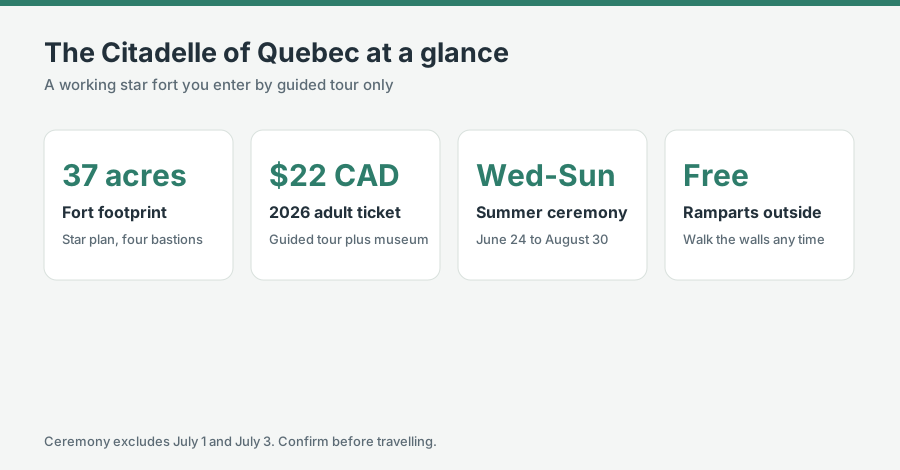
The Citadelle of Québec is an active military base covering 37 acres, built on a polygonal star plan with a bastion at each of four corners. Visits are guided only. Adult general admission in 2026 is $22 CAD and includes a 60-minute guided outdoor tour plus free access to the Royal 22e Régiment Museum.
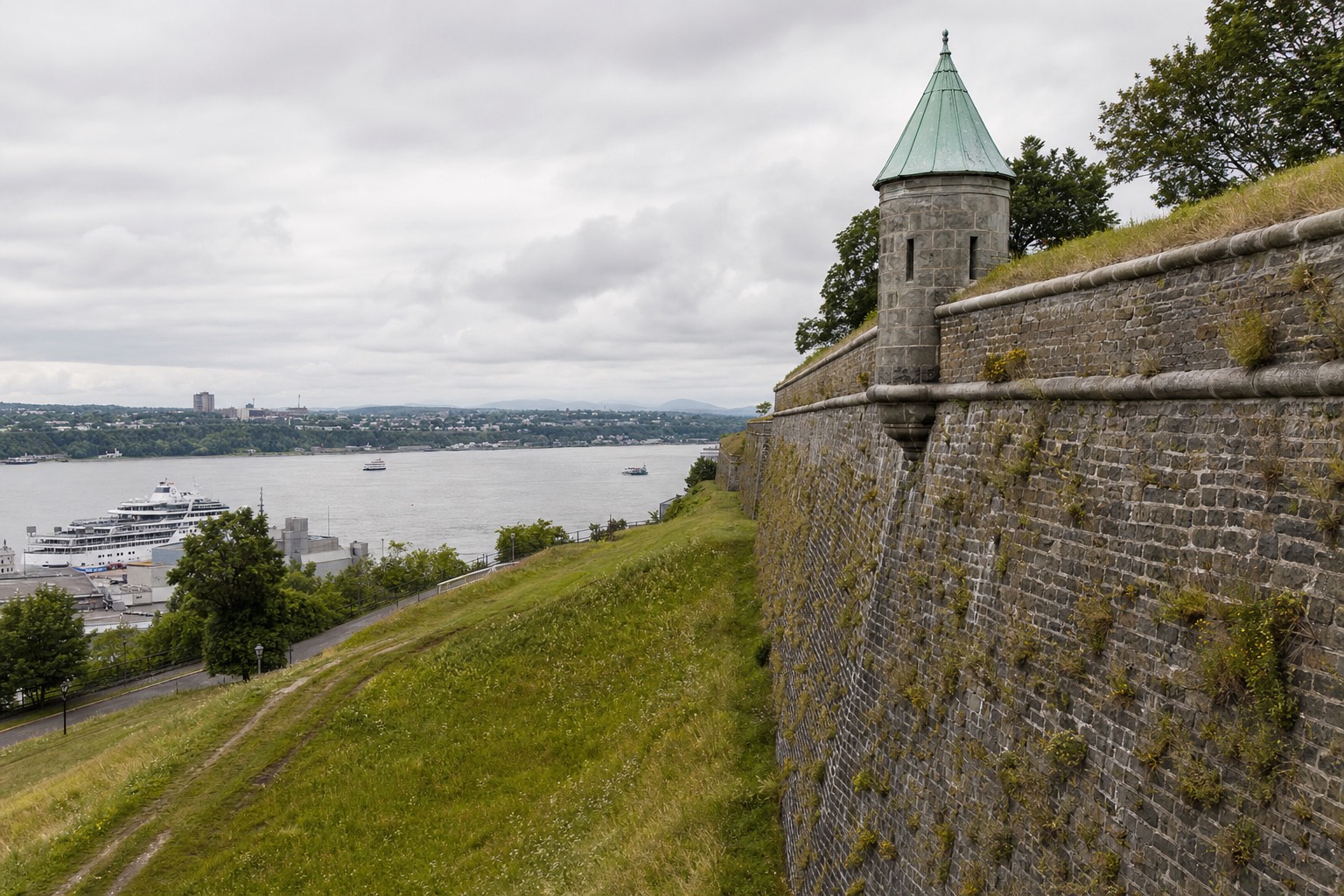
Climb the slope toward the Citadelle gate on a windy morning and you feel the temperature drop before you get there. I pass this ground most weeks with a group trailing behind me, and the fortification never reads as a wall from below. It reads as a mown grass bank, angled, with stone showing only along the top edge. Cannon barrels sit up there pointing out over the St. Lawrence, dark and pitted, and somebody in the group always asks the same question at the same spot. Can we just walk in?
TL;DR: No, you cannot. The Citadelle of Québec is a working military base, not a ruin: 37 acres of fortification on a star plan with a bastion at each of four corners, still home to the Royal 22e Régiment. Visits are guided only. Adult general admission for 2026 is $22 CAD, and that ticket carries a 60-minute guided outdoor tour plus free entry to the Royal 22e Régiment Museum. For summer 2026 the official programme lists Music in Red, band performances that replace the full Changing of the Guard, Wednesday through Sunday at 10 a.m. from June 24 to August 30.
What Is The Citadelle Of Québec, Exactly?
A fortified enclosure covering 37 acres, built on a polygonal star-shaped plan with a bastion at each of its four corners, holding the highest ground above the river. It is not a preserved ruin. The Royal 22e Régiment is based inside, which makes the whole site an active military installation that happens to admit visitors.
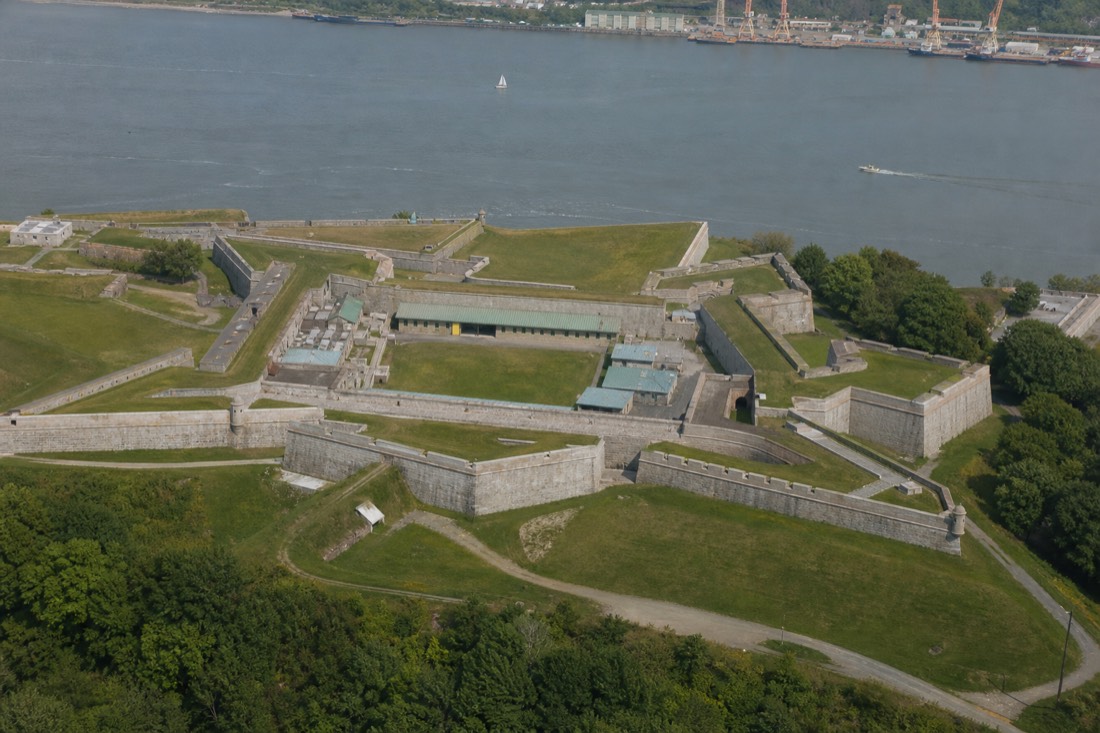
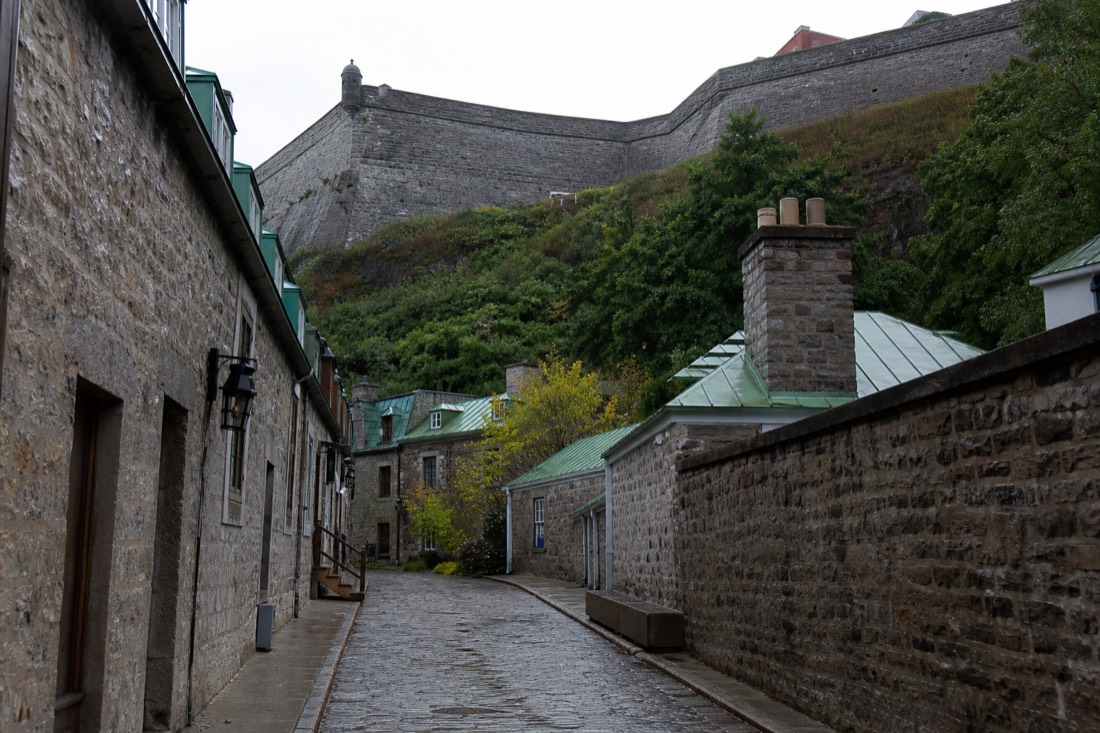
Those dimensions come from the federal heritage record, which describes a 37-acre fortified enclosure on a polygonal star plan with four corner bastions. Star forts were designed so that no attacker could approach a wall without being shot at from an angle he could not see. Stand at the base of one of the bastions and the geometry stops being abstract: the walls fold away from you in both directions, and every retreating angle covers the one beside it.
That design is why the fort sits where it does, at the top of Cap Diamant, closing the landward end of the old town's fortified core. The Citadelle is the anchor point of the whole system I walk visitors through in Old Quebec, the reason the walls run where they run, and part of what makes this the only walled city north of Mexico with its defences still standing. Everything else in the old town, the gates, the ramparts, the batteries above the cliff, points back to this hill.
Can You Visit The Citadelle Of Québec Without A Guided Tour?
No. The Citadelle is an operational base and home to the Royal 22e Régiment, so visits are exclusively guided. The single self-paced exception on the site is the Royal 22e Régiment Museum in the East Casemate near the entrance. The fortifications themselves you see with a guide, or you do not see them.
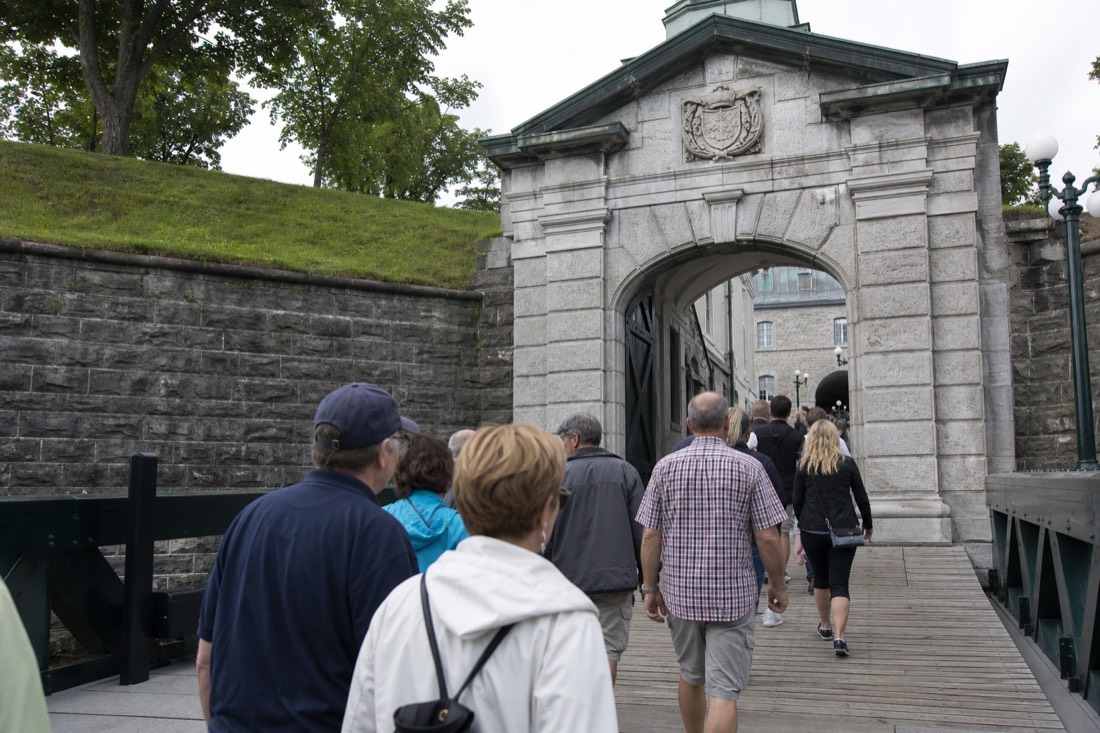
This trips up more visitors than anything else about the place. People arrive having spent three days walking freely through Old Quebec, where nothing is gated and every square is open at any hour, and they expect the fort to work the same way. It does not. The official admission and hours page is direct about it: the guided format exists because the base is operational, not because the site wants to sell tours.
Practically, that means you cannot drift in for twenty minutes on the way past. You commit to the tour's start time and its full length. If your day is already tight, the honest alternative is to enjoy the fort from outside and spend the hour on ground that costs nothing: the open parkland of the Plains of Abraham begins essentially at the fort's western side, and the boardwalk of Dufferin Terrace gives you the same river the gunners were watching. Neither needs a ticket or a timetable.
How Much Are Citadelle Of Québec Tickets In 2026, And What Do They Include?
Adult general admission is $22 CAD for the 2026 season. That one ticket carries a 60-minute guided outdoor tour of the fortifications plus free access to the Royal 22e Régiment Museum. There is no separate museum fee to budget for, and no cheaper wander-the-grounds-alone option, because that option does not exist.
I like this pricing, and I say that as somebody who sells guided walking for a living. One number, one hour with a guide, one museum thrown in, no upsell ladder at the ticket window. Here is what the ticket actually opens.
| What you get | Guided or self-guided | In the $22 CAD adult ticket | Note |
|---|---|---|---|
| 60-minute outdoor tour of the fortifications | Guided | Yes | The only route past the gate |
| Royal 22e Régiment Museum, East Casemate | Self-guided | Yes, free access included | Sits right at the entrance |
| Governor General's Residence (Building 28) | Managed separately | No | Inside the walls but run by a separate organization; public visits are possible under certain conditions |
| Wandering the grounds unaccompanied | Not offered | No | Active base, visits are exclusively guided |
Read the bottom row as the design of the visit rather than a restriction on it. An hour with a guide who works on a functioning garrison is a different product from an hour alone with an audio device, and at $22 CAD it undercuts most of what the old town charges for anything with a person attached.
Is The Changing Of The Guard Still Happening At The Citadelle?
Not in its full form this season. For summer 2026 the official programme lists Music in Red, performances by the Royal 22e Régiment band, in place of the full Changing of the Guard. It runs Wednesday through Sunday at 10 a.m. from June 24 to August 30, 2026, with July 1 and July 3 excepted, weather permitting.
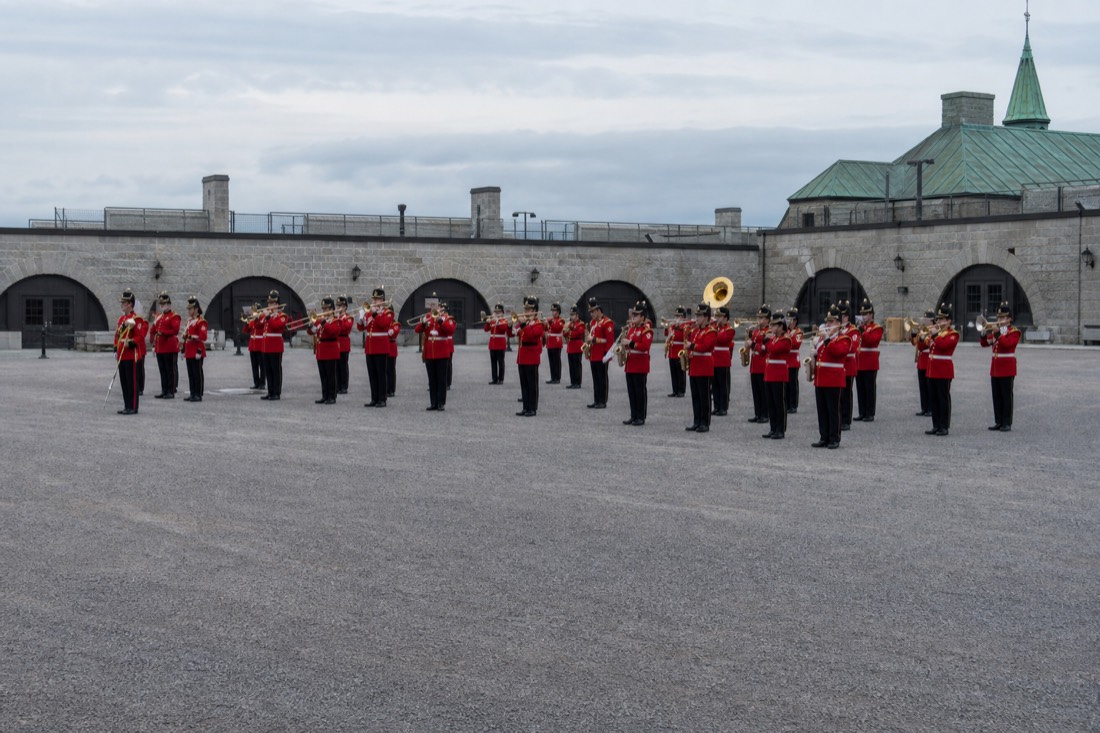
This is the single most useful thing on this page, because a lot of what you will read elsewhere still prints an old ceremony schedule. Check the official Music in Red listing before you build a morning around a ceremony that is not running in the form you are picturing. Turning up at 10 a.m. on a Tuesday in July with children in tow, expecting bearskins and drill, is a bad twenty minutes for everybody.
| 2026 window | What is scheduled | Days | Time | Caveat |
|---|---|---|---|---|
| June 24 to August 30 | Music in Red, Royal 22e Régiment band, in place of the full Changing of the Guard | Wednesday to Sunday | 10 a.m. | Weather permitting |
| July 1 and July 3 | Nothing in the series | n/a | n/a | Both dates specifically excepted |
| Mondays and Tuesdays in season | Nothing in the series | n/a | n/a | The programme runs Wednesday to Sunday only |
| Outside June 24 to August 30 | No summer ceremony listed | n/a | n/a | Plan around the guided admission tour instead |
Weather permitting is not a formality on this hill. The parade ground is completely exposed, wind comes up off the river with nothing to break it, and a bright morning in the lower town can be a raw one at the top of Cap Diamant. Bring a layer more than you think you need, especially outside high summer, and read Quebec City in winter if your trip lands in the cold months and you want to know what that exposure really feels like.
What Is Inside: The Museum And The Governor General'S Residence?
Two things worth knowing about. The Royal 22e Régiment Museum sits in the East Casemate at the entrance, free with general admission and walked at your own pace. The Governor General's Residence, Building 28, stands inside the walls but is managed by a separate organization, with public visits possible under certain conditions.
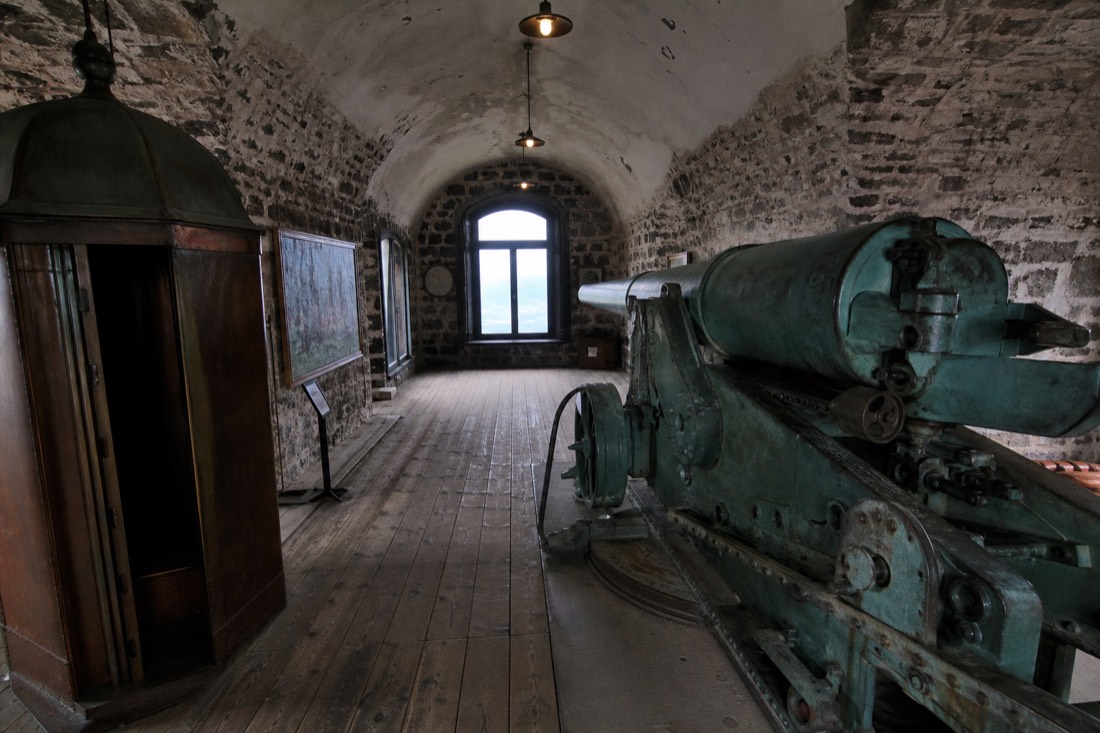
The museum's position matters for planning. It is at the entrance, in the East Casemate, which means you can take it before or after your guided hour without crossing the site again. Groups I send up there tend to do the tour first, warm up in the casemate afterward, and leave having spent close to two hours in total rather than the one the ticket advertises.
The Governor General's residence is the part visitors rarely expect. Canada's head of state has an official residence inside a working fort in the middle of a UNESCO-listed old town, and it operates on its own terms: separate management, separate access rules, public visits possible but conditional. Treat it as a bonus you might catch rather than a box you can plan on ticking. Nothing about the $22 CAD admission ticket promises you the door.
Citadelle Tickets Or A Guided Old Quebec Walking Tour: Which Comes First?
Different products, and most first-time visitors get more out of the walking tour. The Citadelle gives you 60 guided minutes inside one military site for $22 CAD. A two-hour guided walk of Upper and Lower Town gives you the streets, the funicular and the context that makes the fort make sense. Fit both in if you have two days.
I get asked to rank these constantly, so here is the comparison laid flat.
| Citadelle general admission | Old Quebec Classique walking tour | |
|---|---|---|
| What it covers | Inside the star fort: guided outdoor tour plus the Royal 22e Régiment Museum | Upper and Lower Town streets, with the funicular ride included |
| Price | $22 CAD adult, 2026 | From about $41 USD |
| Length | 60 guided minutes | 2 hours |
| Guide | Required, the site's own | Local guide, 4.9 across 1,538 Viator reviews |
| Booking | Official site or the gate | Viator, in advance |
| Best for | Military history, fortification design, the regiment | A first visit, orientation, the old town's streets and stories |
The order I recommend is the walking tour first, on day one, then the Citadelle once you know why a garrison sat up there in the first place. Do it the other way around and the fort arrives without a city attached to it. Every option on that first line lives on the walking tours page, and for the Classique walk specifically, check live availability & prices on Viator before you lock in a morning, because the small-group departures fill fastest in summer.
How Long Should You Allow For A Visit To The Citadelle?
Two hours, not one. The ticket advertises a 60-minute guided outdoor tour, but the Royal 22e Régiment Museum in the East Casemate is included and self-guided, the walk up from Porte Saint-Louis takes about ten minutes at my pace, and the summer band performance runs on its own clock at 10 a.m.
The mistake is treating the advertised hour as the visit. It is the guided part of the visit. Around it sits an approach on foot, a ticket window, a museum you have already paid for, and, if your date lands inside the summer window, a performance that starts when it starts. Groups I send up there routinely come back down around the two-hour mark and tell me it did not feel long.
Slot the guided hour wherever that day's departures put it, then build outward. If Music in Red is running and you want it, the 10 a.m. start is the pin in your morning and everything else moves around that. If it is not running, the museum is the flexible piece: take it before the tour if the weather looks like turning, after if it looks fine.
One warning about the walk up. The approach from Porte Saint-Louis is exposed the whole way, and the temperature at the gate is not the temperature you left at Place d'Armes. Ten minutes at a guiding pace, longer if the wind is up.
| Slot | What is happening | My planning allowance | Fixed or flexible |
|---|---|---|---|
| Before you leave | Check the day's tour times and the Music in Red listing | 5 min online | The one step people skip |
| 9:20 to 9:30 | Porte Saint-Louis up to the Citadelle gate | about 10 min | Flexible, but exposed |
| 9:30 to 9:50 | Ticket window, $22 CAD adult, then the East Casemate museum | about 20 min | Flexible, self-guided |
| From 10:00 | Music in Red on the parade square, Wednesday to Sunday, June 24 to August 30 | starts 10 a.m., weather permitting | Fixed, and seasonal |
| The guided hour | 60-minute outdoor tour of the fortifications | 60 min | Fixed, and the only route past the gate |
| Afterwards | Museum if you saved it, then back out | about 30 min | Flexible |
| Leaving | Plains of Abraham, or the cliff walk back to Dufferin Terrace | 5 to 15 min | Free either way |
What Does A Morning At The Citadelle Cost End To End?
Twenty-two Canadian dollars, and that is genuinely the whole bill. Adult admission carries the guided hour and the regimental museum, with no second ticket anywhere on site. The ramparts walk, the Plains of Abraham and Dufferin Terrace on either side of it cost nothing, so a full fort morning can end at one line item.
I price a lot of mornings for people, and this one is unusually clean. There is no audio-guide upsell, no museum surcharge, no premium tier that gets you further in. The fort is an active base, so there is nothing further in to sell you. What you pay is what the gate costs.
That matters more than the number itself, because everything you would naturally attach to a Citadelle morning is free. Walk the ramparts to get there. Walk the Plains after. Drop back down the cliff to the terrace when you are done. A visitor doing the whole upper-town military circuit spends $22 CAD and a good pair of shoes.
The one line that trips people up is the Governor General's Residence. It stands inside the same walls, but it is run by a separate organization with its own access conditions, and your admission ticket makes no promise about it. Treat any glimpse of Building 28 as luck.
| Line item | Cost | Covered by the $22 CAD ticket? |
|---|---|---|
| Citadelle general admission, adult, 2026 | $22 CAD | This is the ticket |
| 60-minute guided outdoor tour | No extra charge | Yes |
| Royal 22e Régiment Museum, East Casemate | No extra charge | Yes, and self-guided |
| Governor General's Residence, Building 28 | Separately managed | No, visits possible under certain conditions |
| Music in Red on the parade square | No separate listing price found | Confirm on the official listing before you plan around it |
| Ramparts circuit, four gates, three Martello towers | Free | Outside the ticket |
| Plains of Abraham parkland | Free | Outside the ticket |
| Dufferin Terrace boardwalk | Free | Outside the ticket |
| Adding the Classique guided walk of the old town | From about $41 USD | Separate product, separate day if you can |
Is The Citadelle Manageable If Slopes And Stairs Are A Problem?
Partly, and the honest answer depends on the part. The approach is a paved uphill about ten minutes long, the glacis is a slope by design, and the parade square is flat but fully exposed. Inside, the tour is guided only, so the group sets the pace and you cannot shorten the route.
That last point is the one to weigh before you buy. Everywhere else in Old Quebec you can stop, sit, turn around or bail out. Here you are on a guided route inside a working military installation for sixty minutes, and the honest thing to do is call or ask at the ticket office first rather than find out halfway round.
For guests who tell me stairs are the issue rather than distance, the fort is often still fine and the surrounding walk is often the harder part. The ramparts have stairs at their access points and uneven footing throughout. The Plains of Abraham, by contrast, opens straight off the fort's western side as flat parkland, and Dufferin Terrace at the far end of the cliff walk is a long level boardwalk. Plan the route in, not just the visit.
The wind is the thing nobody warns about. There is nothing between the parade square and the river, and a mild morning in the lower town can be a hard one at the top of Cap Diamant.
| Stage of the visit | The ground | What I tell guests |
|---|---|---|
| Porte Saint-Louis to the gate | Paved, uphill, exposed, about 10 min at my pace | Slow down; the climb is the warm-up, not the visit |
| The glacis outside the walls | A continuous grass bank by design | Look at it from the level path, do not cross it |
| Inside the fort | Guided only, group pace, full 60 minutes | Ask at the ticket office before buying, not after |
| Royal 22e Régiment Museum | East Casemate, at the entrance, self-guided | The one part you set the pace for, or skip entirely |
| Parade square during Music in Red | Flat, open, fully exposed to river wind | Layers, and a plan for the weather cancelling it |
| Leaving west | Open parkland off the fort's western side, about 5 min | The flattest way out |
| Leaving north | About 15 min along the cliff, then level boardwalk | The scenic way out, step-light once you reach the terrace |
How Does The Citadelle Fit Into A Walk Of The City Walls?
It anchors the whole circuit. The Citadelle closes the landward end of the fortifications, so the natural route runs from Porte Saint-Louis along the walls to the fort's glacis, inside for the guided hour if you have a ticket, then out onto the Plains of Abraham or back down to Dufferin Terrace along the cliff.
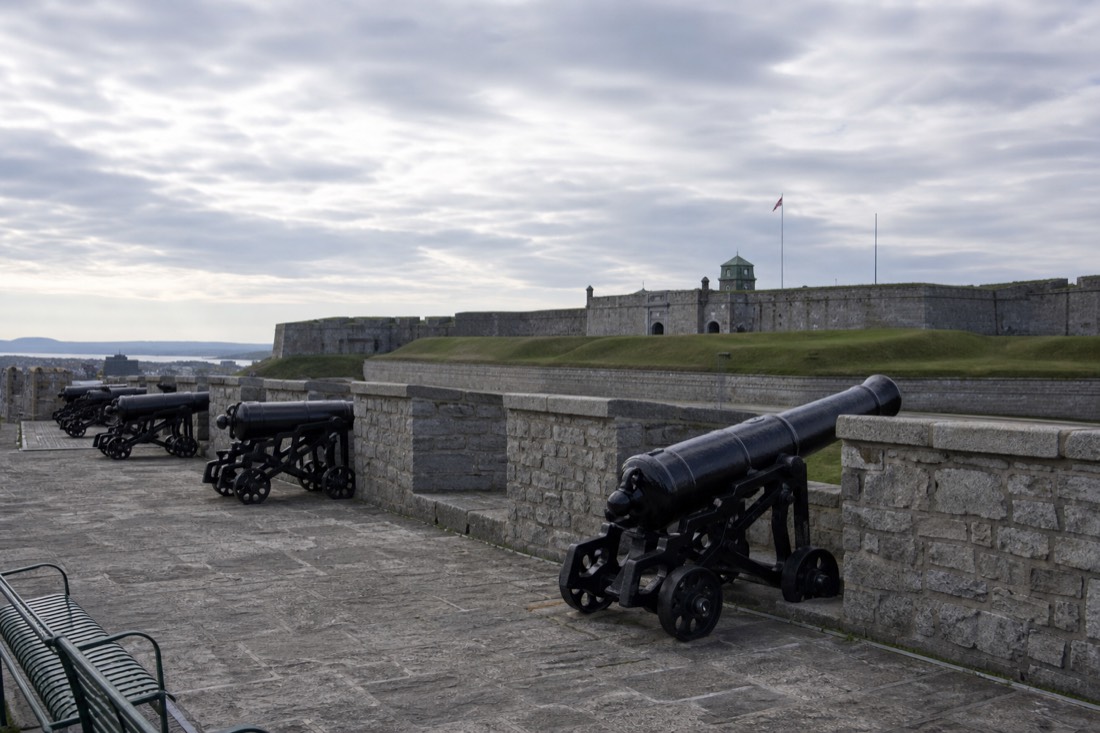
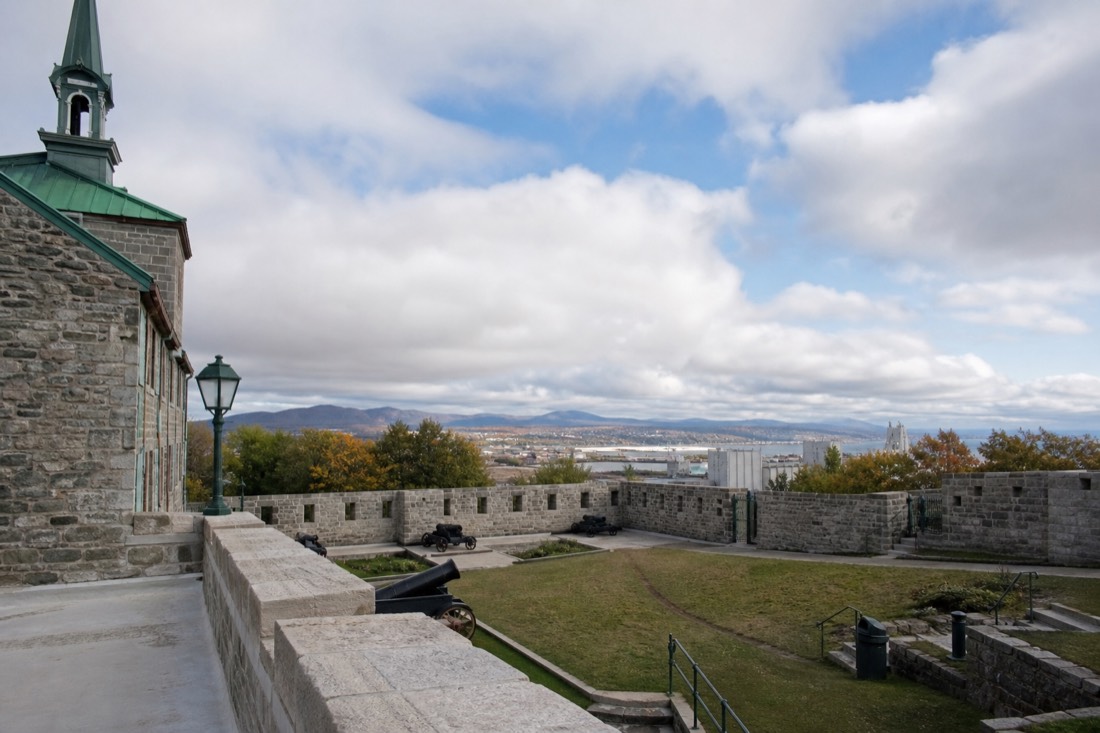
The city counts 4.6 km of ramparts, four gates and three Martello towers wrapping the upper town, with the Citadelle as the heavy end of the system. Walking that line is free, and it is the leg where the cannon get interesting: barrels lined up along the walkway, still aimed at the water, close enough to put a hand on. The minutes below are my own guiding pace, not a survey.
| Leg | My pace | Ticket | What it adds |
|---|---|---|---|
| Porte Saint-Louis to the Citadelle gate | About 10 min | Free | The outer angles of the star plan, seen from the glacis |
| Inside the Citadelle | 60 min | $22 CAD adult | The only way past the gate: guided tour plus the museum |
| Citadelle to the Plains of Abraham | About 5 min | Free | Open parkland opening straight off the fort's western side |
| Citadelle back to Dufferin Terrace | About 15 min | Free | Cliff-edge river views and the cannon along the ramparts |
| The full ramparts circuit | About 40 min | Free | 4.6 km of walls, four gates, three Martello towers |
Slot that into the free loop I give away in the self-guided walking route and the fort becomes the high point of a morning rather than a separate errand. Finish by dropping off the cliff into Petit Champlain for lunch, which is the correct reward for an hour spent on a windy parade square.
One last thing from someone who walks past those walls more than most. The Citadelle is the only part of Old Quebec that will not let you improvise, and that is exactly what makes it worth the ticket: for sixty minutes you are inside a place that is still being used for the thing it was built for.
Your Next Step
Choose Your Quebec Experience
General recommendation, before you add preferences. Confirm dates and participation requirements with the operator.
Have your travel date in mind? Enter the fortress with a guided tour and access to the Royal 22e Régiment museum. Check the departure before arranging the rest of your day.
The ticket covers the fortress visit and museum. Confirm the language, guided departure and access requirements on the listing. Allow three hours for arrival, the guided visit and museum time. This is a planning allowance, not a fixed ticket duration.
Choose your exact date and party on GetYourGuide using the booking link below, then confirm both before booking.
Compare Options And Fit Your Plans
Enter the fortress with a guided tour and access to the Royal 22e Régiment museum. The ticket covers the fortress visit and museum. Confirm the language, guided departure and access requirements on the listing. Allow three hours for arrival, the guided visit and museum time. This is a planning allowance, not a fixed ticket duration.
Explore the fortifications and historic gates with a licensed guide in period military costume. 2 hours in English or French; meet at the Wolfe-Montcalm Monument, 7 Rue des Carrières. An outdoor heritage circuit; Citadelle and battlefield museum entry are not included.
Connect Place Royale, Petit Champlain and the upper town with a licensed guide and an included funicular ride. 2 hours; meet at 112 Rue Saint-Paul and finish near City Hall. Hotel pickup is excluded.
Affiliate links: we may earn a commission at no extra cost to you.