The Only Walled City North Of Mexico: Walking Quebec'S Fortifications
Quebec City is the only fortified city north of Mexico. A local guide walks you through the 4.6 km of ramparts, the four gates, the Citadelle and the UNESCO story.
 By Jean-Pierre Tremblay, Quebec City tour guide & heritage specialist
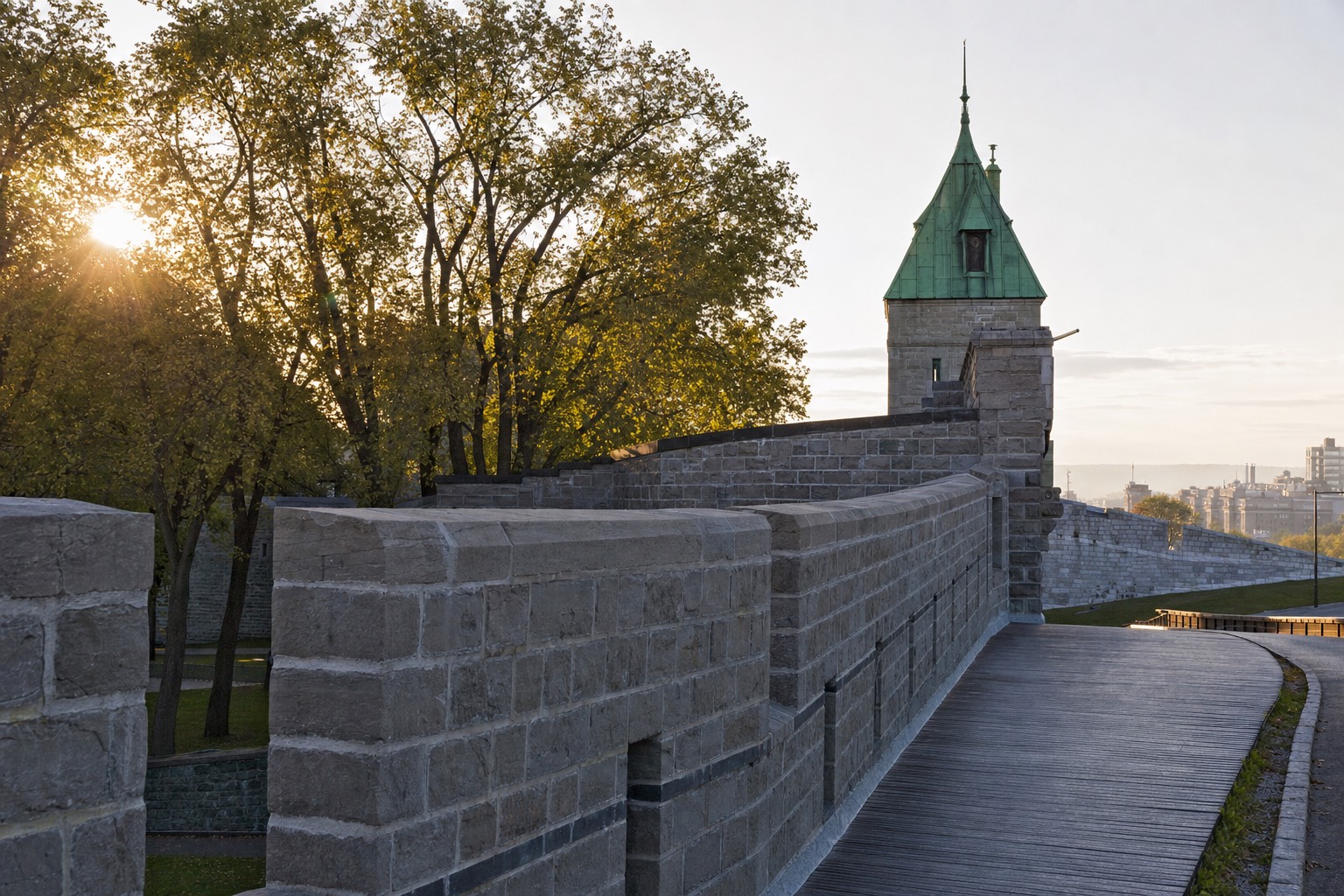
Put your palm flat on the stone beside Porte St-Louis at seven in the morning and it is still cold from the night, even in July. Buses have not arrived yet. A commuter cycles through an archway that soldiers once shut against sieges, and nobody around finds that remarkable. I have guided these walls since 2022, and that morning indifference is my favourite thing about them: the fortifications are not a museum piece roped off behind glass. They are the working edge of a living neighbourhood.
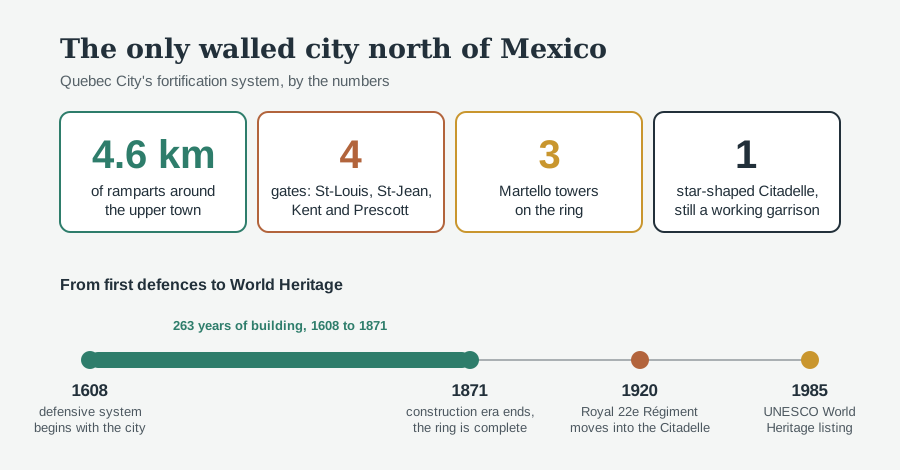
TL;DR: Quebec City is the only fortified city north of Mexico, ringed by 4.6 km of ramparts with 4 gates, 3 Martello towers and a star-shaped Citadelle. The full wall circuit takes about 90 minutes at a steady pace, half a day if you do it properly. UNESCO put the district on the World Heritage List in 1985.
What Is The Only Walled City In North America?
Quebec City. Its defensive system, built between 1608 and 1871, survives as 4.6 km of ramparts around the upper town, and UNESCO calls it the only North American city to have preserved its ramparts. The careful phrasing is "north of Mexico," which is how the city's own tourism office words it.
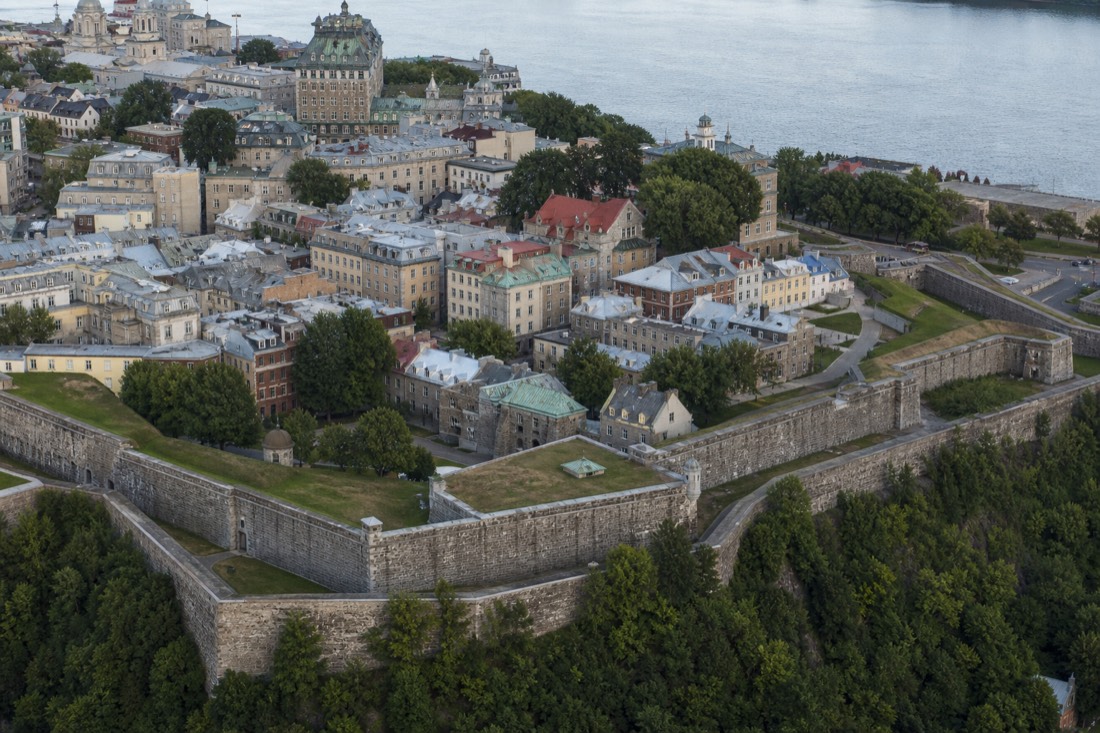
You will meet both versions of the claim, and the difference is worth thirty seconds. The tourism office describes Quebec as the only fortified city north of Mexico, a defensive system raised between 1608 and 1871 under two empires. UNESCO's listing goes at it from the other side: among North American cities, only Quebec still has its ramparts. Both statements describe the same rare survival. Almost every colonial town on this continent had defensive works at some point. The others tore theirs down as they grew. Quebec kept the ring.
What survives today is a complete system, not a fragment: 4 gates, 3 Martello towers, the Citadelle, and those 4.6 km of continuous rampart wrapping the upper town. When guests ask me why the old town feels different from every other "historic district" they have visited, that ring is the answer. The wall gives Old Quebec a hard edge. You are inside or you are outside, and you feel the change the moment you pass under an arch.
How Long Does It Take To Walk Around Old Quebec?
About 90 minutes for the full 4.6 km rampart circuit at a steady pace with no stops. Budget two and a half to three hours once you add photo stops at the gates and viewpoints, and half a day if you fold in the Citadelle and a descent to Lower Town.
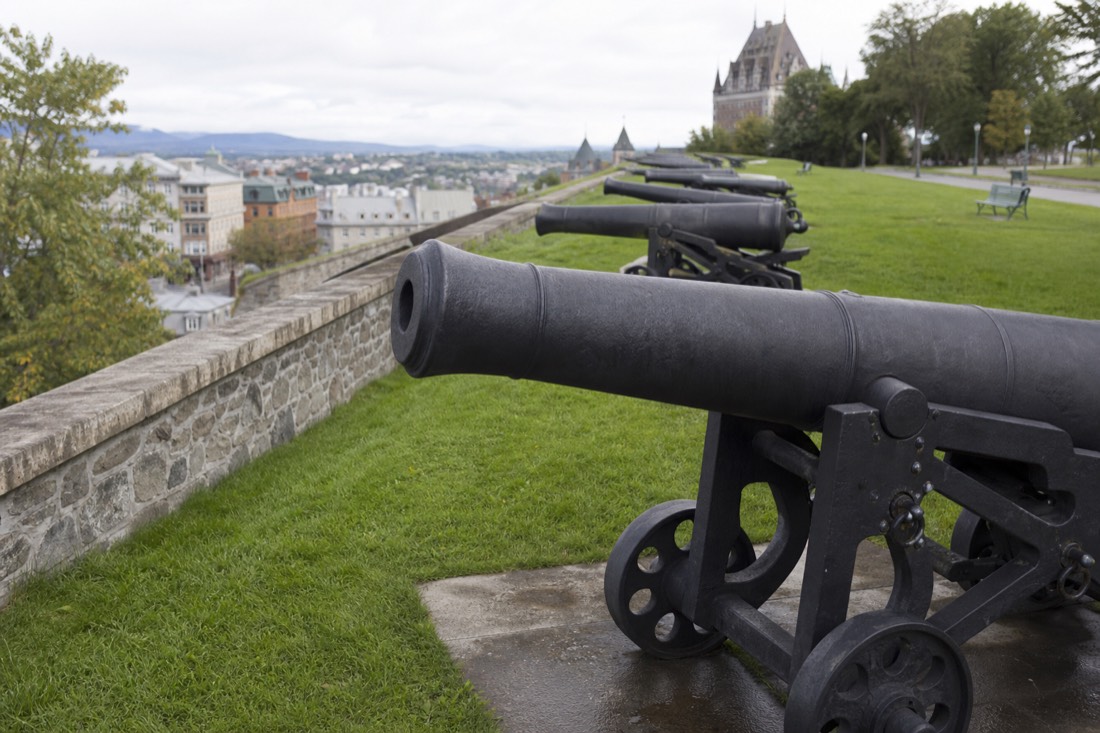
The arithmetic is simple. The ring measures 4.6 km, ordinary city walking covers about 4.5 km an hour, and the terrain adds a little because this is a hill town with stairs. Nobody actually walks it that way, though. The wall keeps interrupting you with things: a rank of cannons aimed at the river, a view down over the rooftops of Rue St-Jean, the sudden green sweep toward the Citadelle glacis. My groups take two hours to cover ground I could walk alone in forty minutes, and no one has ever complained.
| Plan | Time | What it covers |
|---|---|---|
| Straight circuit, no stops | ~90 min | The full 4.6 km ring at a steady pace |
| Gate-to-gate with photo stops | 2.5 to 3 h | The circuit plus viewpoints, cannons, all four gates |
| Circuit plus the Citadelle | Half a day | The ring and the star fort at its southern anchor |
| Full fortifications day | Full day | Walls, Citadelle, then down through Porte Prescott to Lower Town |
Two practical notes from someone who does this weekly. Wear real shoes: sections of the walk are grass, gravel and worn stone, and the stair count sneaks up on you. And walk the ring counter-clockwise from Porte St-Louis if you want the river views to build rather than peak early. If you would rather have the route handed to you turn by turn, my self-guided walking route covers the walls and the Lower Town in one loop.
What Are The Four Gates In Quebec City'S Walls?
Porte St-Louis, Porte St-Jean, Porte Kent and Porte Prescott. Today's fortifications count exactly 4 gates, each puncturing the ring at a different mood: ceremonial St-Louis, busy St-Jean, quiet Kent, and Prescott, the one that carries you over Côte de la Montagne toward Lower Town.
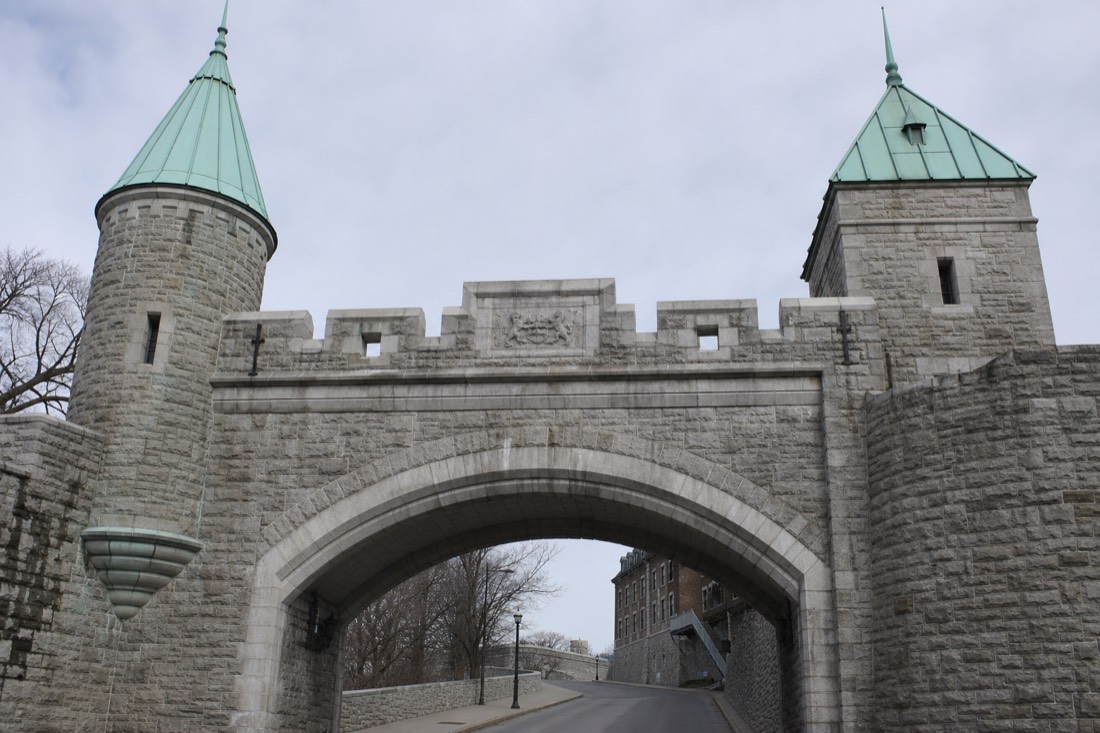
Each gate earns a stop, and each rewards a different appetite.
| Gate | Where it stands | What you find there |
|---|---|---|
| Porte St-Louis | Rue St-Louis, southwest ring | The postcard gate. Parliament Hill just outside, the Château Frontenac a ten-minute walk inside |
| Porte St-Jean | Rue St-Jean, western ring | The busiest crossing. Place D'Youville outside, the restaurant-lined run of St-Jean inside |
| Porte Kent | Rue Dauphine, steps from St-Jean | The quiet one. Best gate for photographs without crowds in them |
| Porte Prescott | Over Côte de la Montagne | The vertical gate. Crosses above the road that links Upper Town to Petit Champlain and the Casse-Cou stairs |
St-Louis is the gate every tour photographs, and fair enough, it is the handsome one. But St-Jean is where the wall still does its original job of separating worlds: pass under it at dinner time and you trade the hush of the old town for the noise of one of the city's best eating streets more or less instantly. Half the tables my guests rave about sit within five minutes of that arch, which is why I usually point hungry walkers at the food tours that work this exact stretch. Prescott is the odd one out, less a door than a bridge, and the drop beneath it toward Lower Town is the single steepest change of scene in the city.
Should You Walk The Fortifications Alone Or With A Guide?
Both work, honestly. The wall walk is free-form and hard to get lost on, so confident walkers do fine solo with a good route. A guide earns the fee on the stories the stones do not tell: why two empires kept rebuilding this ring for 263 years, what the gates were built to control, and how a military corset became a UNESCO asset.
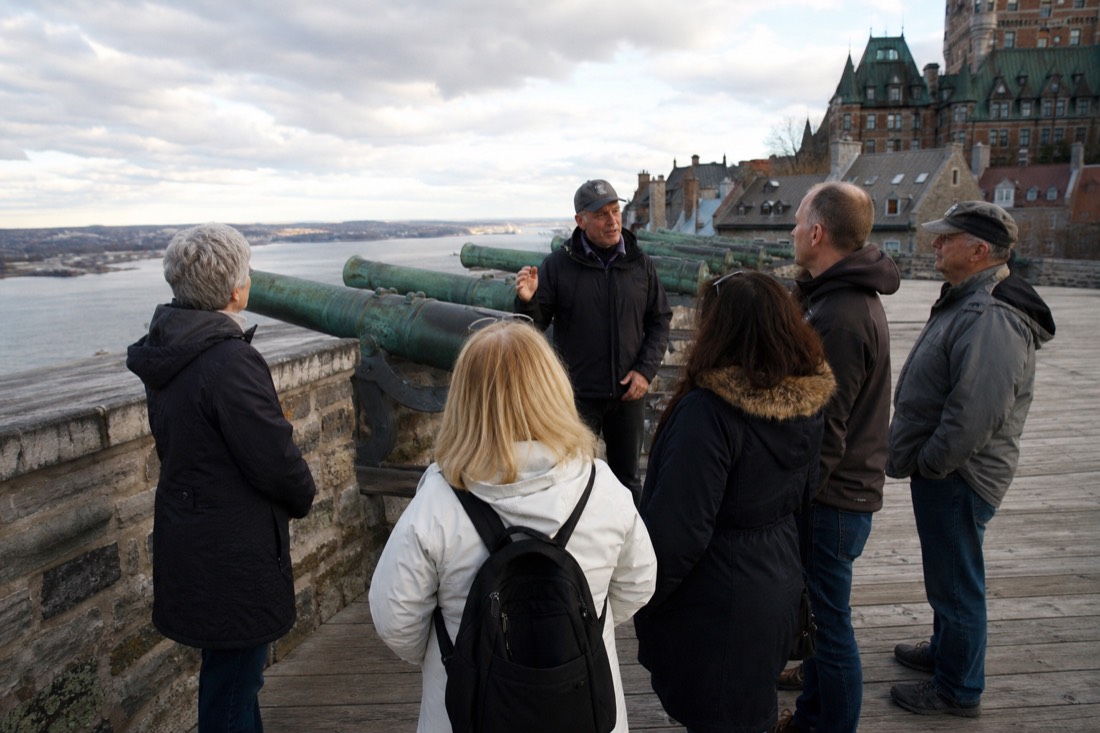
I am a guide, so discount my bias as you see fit. But the pattern I see is consistent. Guests who walked the walls alone the day before a tour tell me the same thing: beautiful, and mute. The fortifications do not explain themselves. There is no narrative signage along most of the circuit, and the difference between a bastion and a redoubt stays invisible until someone points at the angles and shows you what they were for.
If you want that layer, the two-hour Upper and Lower Towns walk from Tours Voir Québec is the one I send people to first. It pairs the walled town with the descent to Place Royale, and it sits at 4.8 stars across 4,995 Viator reviews, the deepest review base of any walk in the city. Compare it with the rest on the walking tours page, and check live availability & prices on Viator before your dates fill, because mornings in high season do.
Going solo instead? Take water, take the counter-clockwise route, and give yourself permission to bail through any gate when your legs vote no. The ring always hands you back to a café.
What Is The Citadelle, And Can You Visit It?
The Citadelle of Quebec is the star-shaped fortress anchoring the southern end of the fortifications, and it is still a working garrison: the Royal 22e Régiment has made it home since 1920. That makes it North America's rare active fort inside a UNESCO-listed district, visitable while soldiers actually live and work there.
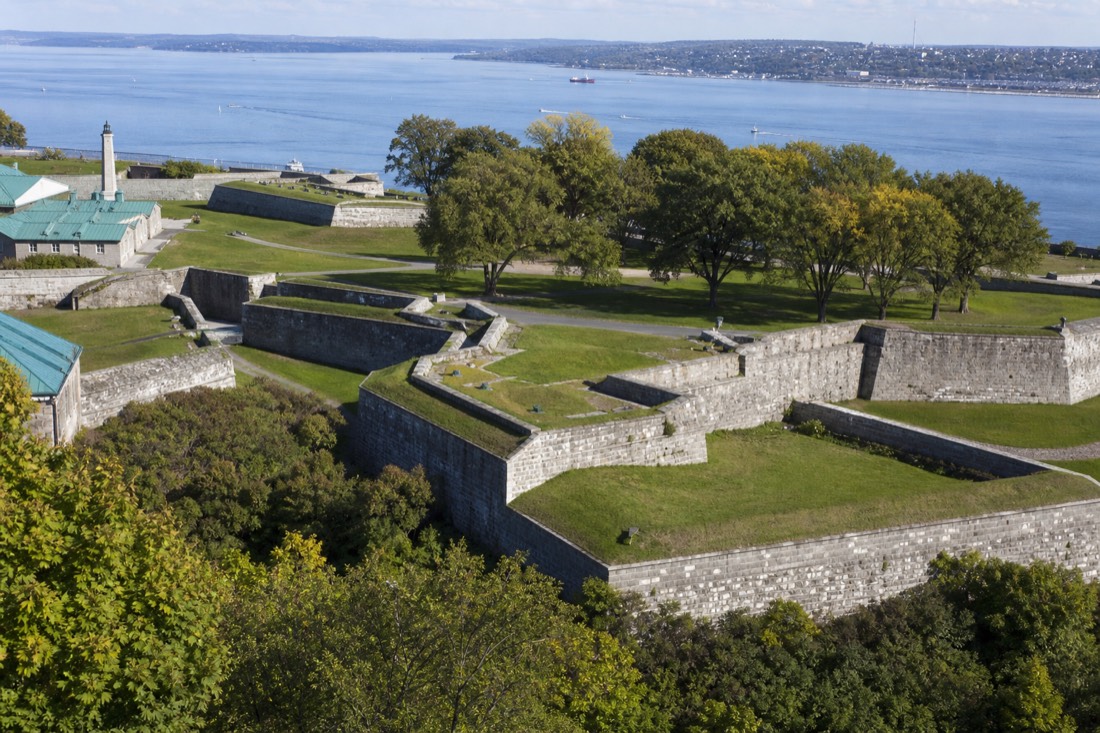
From the rampart walk, the Citadelle first appears as a green swelling of earthworks, which is the point: a star fort is designed to hide its strength low against artillery. Parks Canada's heritage designation describes the star-shaped fortress as home to the Royal 22e Régiment since 1920, and that residency changes the feel of a visit. This is not re-enactment. The sentries are serving members of the Canadian Armed Forces, and the regiment's presence turns what could be a fossil into a workplace with a hundred years of continuous tenancy.
Give it real time rather than a drive-by glance from the wall. My guests who squeeze the Citadelle into twenty minutes regret it; the ones who give it two hours, often stacked onto a morning wall walk, call it the day's surprise highlight. It slots naturally into a bigger old-town day alongside the terrace and the château, and if the Frontenac is on your list anyway, my notes on visiting the Château Frontenac cover how to pair the two without backtracking.
What Is The Best Hour To Walk The Ramparts?
Before eight in the morning, and it is not close. The coach groups have not arrived, the stone is still cold from the night, and the gates photograph without a single stranger in them. Late afternoon is the second window, when the light runs low along the wall and the day-trippers have started leaving.
The ring never gets crowded in the way a single attraction does, because 4.6 km of wall spreads people thin. What clogs are the pinch points: Porte St-Louis, where the tours start, Dufferin Terrace, and the steep link down to Petit Champlain. Walk counter-clockwise from St-Louis early and you stay ahead of all three for the whole loop.
Cruise-ship days and high-season mornings are the exception worth planning around. Between about ten and one the terrace becomes a moving belt of people and the Casse-Cou stairs back up, which matters if you were counting on that descent as part of your route. Nothing about the wall itself changes, but your pace does. Late afternoon fixes it, and after dark the circuit is quiet, lit and still legible, though the grass sections are best left for daylight.
| Hour | What the ring is like | Where the crowd is |
|---|---|---|
| 7:00 to 8:30 | Empty, cold stone, commuters cycling under the arches | Nowhere yet |
| 8:30 to 10:00 | Filling from Porte St-Louis inward | First groups at the postcard gate |
| 10:00 to 13:00 | The busiest stretch; the Casse-Cou stairs back up in high season | St-Louis, Dufferin Terrace, Petit Champlain |
| 13:00 to 16:00 | Steady and walkable, warm on the grass sections | The gates and the terrace |
| 16:00 to sunset | Thinning fast, low light along the wall | Leaving with the day trips |
| After dark | Quiet and lit, the shape of the ring still readable | Outside Porte St-Jean, on the restaurant street |
Can You Walk The Fortifications With A Stroller Or Limited Mobility?
Partly. The rampart top is grass, gravel and worn stone with steps in places, so the full 4.6 km ring is not a step-free route. Flat sections near the gates and along the western wall handle a stroller well. The link down to Lower Town is the hard part, and the funicular solves it.
I walk this circuit most weeks, and the question I get wrong least often is where to send someone with wheels. The honest answer is a partial loop rather than the whole ring. Street level runs parallel to the wall for most of its length, which means you can follow the fortifications without being on top of them, then rejoin the rampart walk where the surface allows.
The gates are the natural bail-out points, and that is the real trick with limited mobility here: the ring hands you back to a street every few hundred metres. Nobody is committed to finishing. Below is my own read on the sections, based on walking them in every season, not an official accessibility assessment. Surfaces change with weather, and winter turns the grass stretches and the steep links into a different problem entirely, so treat cold-month plans as their own question.
| Section | Surface and gradient | Step-free? | My judgment |
|---|---|---|---|
| Porte St-Louis to Porte Kent | Grass and gravel along the top, gentle | Mostly, with detours to street level | The easiest stretch with a stroller |
| Porte St-Jean crossing | Paved, street level, busy | Yes | Fine, though the pavement narrows at the arch |
| Rampart top by the Citadelle glacis | Open grass slope, uneven in places | No | Take the street below instead |
| Porte Prescott and Côte de la Montagne | Steep, the sharpest drop in the old town | No | Use the funicular, not this |
| Casse-Cou stairs | Stairs, and the name is a warning | No | Avoid with wheels, luggage or bad knees |
| Dufferin Terrace | Flat boardwalk | Yes | The best level walking in Old Quebec |
| The full 4.6 km circuit | Mixed, with steps | No | Plan a partial loop and leave through a gate |
What Is The Cheapest Way To Do The Walls, And What Does A Guide Add?
Walking the ring costs nothing at all. A self-guided Viator route starts at $6 USD, a two-hour guided walk with the funicular runs from $41 USD, and the deepest-reviewed option, Tours Voir Québec's Upper and Lower Towns walk, sits at 4.8 across 4,995 reviews. Price tracks how much story you want.
There is no ticket booth on the ramparts, no turnstile, no queue. That is unusual for a UNESCO-listed fortification system and it is worth saying plainly, because visitors regularly ask where to buy wall access. You buy interpretation, not entry. What separates the options below is how much of the 263-year story arrives with the view, and whether somebody else is choosing the route.
The self-guided listing is the budget bridge: cheap, structured, and enough to stop you wandering the ring in the wrong direction. Guided walks are the step up, and the two-hour formats pair the walled town with the descent to Place Royale, which is the pairing that makes the geography click. Review depth is the signal to read here rather than star rating alone, since a 5.0 built on 158 reviews is a thinner sample than a 4.8 built on almost 5,000.
| Way to do the walls | Cost | Reviews | What you get |
|---|---|---|---|
| On your own with a map | Free | n/a | The ring, the gates, and no explanation |
| Self-guided Viator route | From $6 USD | No rating yet, a newer listing | A structured order to walk it in |
| Old Quebec Classique walk with funicular, 2 h | From $41 USD | 4.9 across 1,538 Viator reviews | Guided upper town plus the drop to Lower Town |
| Tours Voir Québec, Upper and Lower Towns, 2 h | Price on the listing | 4.8 across 4,995 Viator reviews | The deepest review base of any walk in the city |
| Urban Horizons certified-guide walk, 2 h 15 | Price on the listing | 5.0 across 158 reviews | A smaller, newer operation with a high but thin score |
| Hop-on hop-off double-decker | Price on the listing | 4.4 across 1,665 GetYourGuide reviews | The ring seen from outside, and the hills done for you |
Why Is Old Quebec A UNESCO World Heritage Site?
Because the ring survived. UNESCO inscribed the Historic District of Old Québec on the World Heritage List in 1985, singling out that Quebec is the only North American city to have preserved its ramparts. The listing protects the whole defensive ensemble: walls, gates, towers and the Citadelle together.
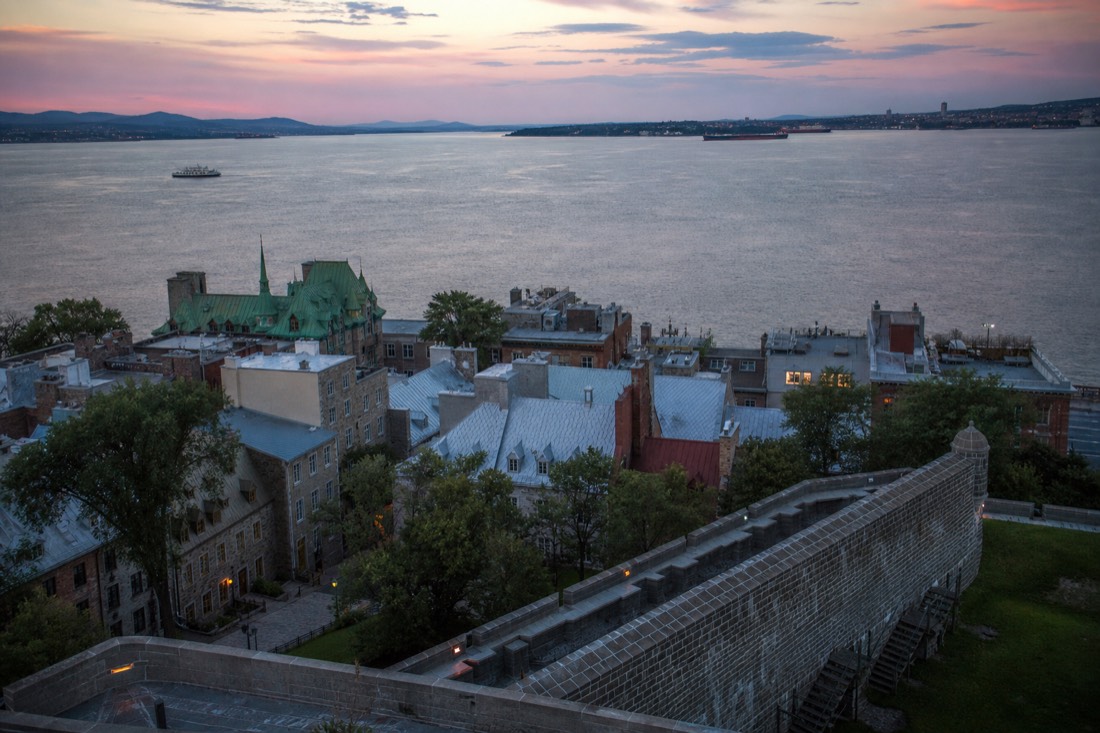
The dates tell the story better than adjectives do. The defensive system took shape across 263 years, and then the recognition came more than a century after the last stone of the construction era.
| Year | What happened |
|---|---|
| 1608 | The defensive system's story begins with the city itself; fortification work spans the centuries that follow |
| 1871 | The construction era closes; the system reaches the form you walk today |
| 1920 | The Royal 22e Régiment takes up residence in the Citadelle, a tenancy that continues now |
| 1985 | UNESCO inscribes the Historic District of Old Québec on the World Heritage List |
Read the UNESCO listing and you will notice how much weight it puts on completeness. Plenty of cities kept a gate as a traffic ornament or a wall fragment beside a parking lot. Quebec kept the system: ring, gates, towers, fort, and the urban fabric inside it, which is why the whole district carries the designation rather than a single monument.
For me the designation matters less as a plaque than as a promise. It is the reason the morning I described at the top still exists: cold stone, a cyclist under the arch, a fortification ring quietly doing nothing at all except holding a neighbourhood in its arms. Walk it early, walk it slow, and if you are still deciding what else the city owes you, the full list of things to do in Quebec City starts, naturally, at the walls.
Your Next Step
Choose Your Quebec Experience
General recommendation, before you add preferences. Confirm dates and participation requirements with the operator.
Have your travel date in mind? Explore the fortifications and historic gates with a licensed guide in period military costume. Check the departure before arranging the rest of your day.
2 hours in English or French; meet at the Wolfe-Montcalm Monument, 7 Rue des Carrières. An outdoor heritage circuit; Citadelle and battlefield museum entry are not included.
Choose your exact date and party on GetYourGuide using the booking link below, then confirm both before booking.
Compare Options And Fit Your Plans
Explore the fortifications and historic gates with a licensed guide in period military costume. 2 hours in English or French; meet at the Wolfe-Montcalm Monument, 7 Rue des Carrières. An outdoor heritage circuit; Citadelle and battlefield museum entry are not included.
Connect Place Royale, Petit Champlain and the upper town with a licensed guide and an included funicular ride. 2 hours; meet at 112 Rue Saint-Paul and finish near City Hall. Hotel pickup is excluded.
Enter the fortress with a guided tour and access to the Royal 22e Régiment museum. The ticket covers the fortress visit and museum. Confirm the language, guided departure and access requirements on the listing. Allow three hours for arrival, the guided visit and museum time. This is a planning allowance, not a fixed ticket duration.
Affiliate links: we may earn a commission at no extra cost to you.