Where To Stay In Quebec City: Upper Town Vs Lower Town Vs Outside The Walls
One cliff splits Old Quebec into two famous halves, and a wall separates both from everywhere cheaper. Here is how the five real choices compare, from a guide who walks them every week.
 Written with Jean-Pierre Tremblay, Quebec City tour guide & heritage specialist
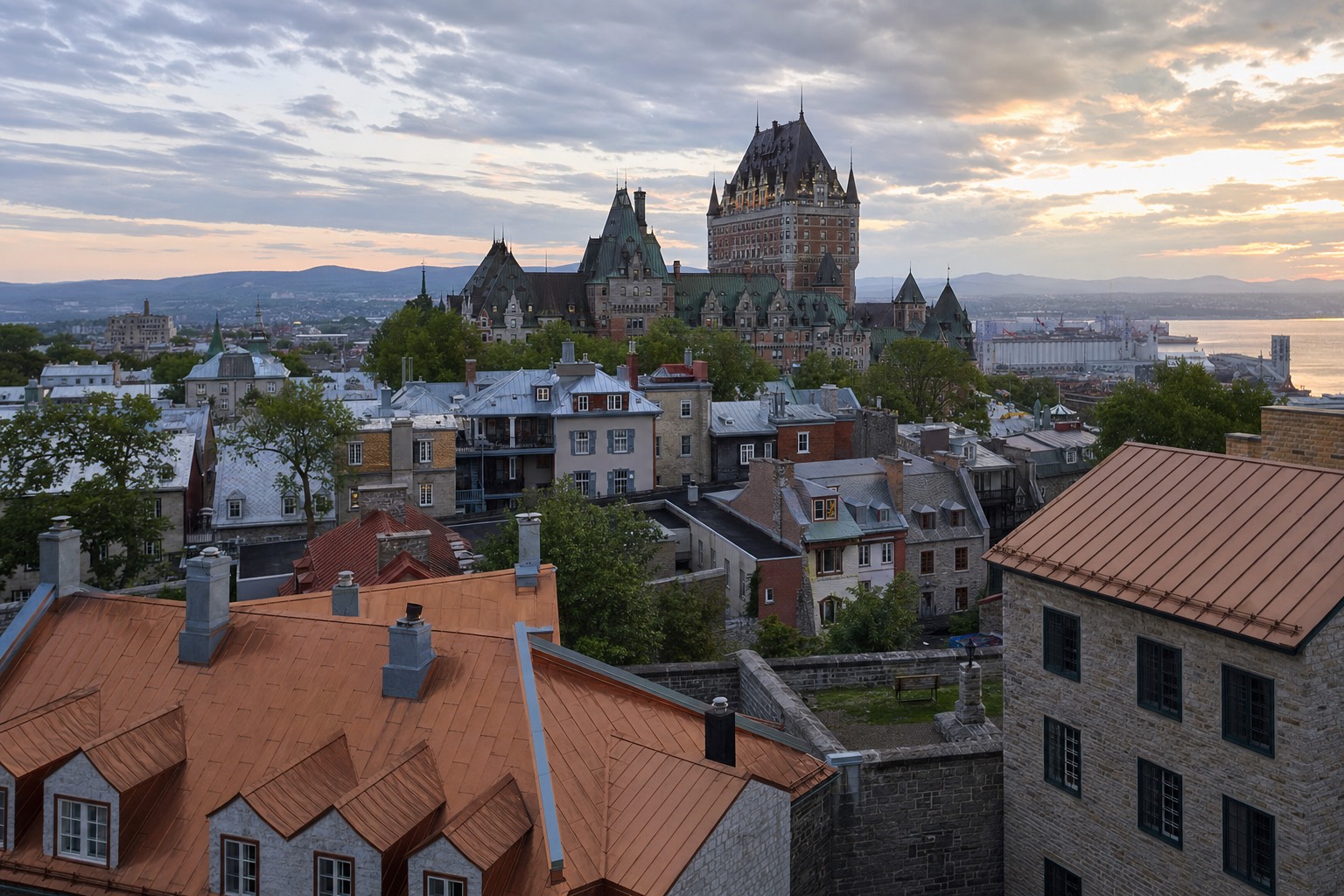
Short answer
First visit without a car: sleep in Upper Town, inside the walls. Couples wanting the prettiest streets at night: Lower Town around Petit Champlain. Cruise arrivals: the Old Port. Food and nightlife on a smaller budget: Saint-Roch. Travelling by car with waterfalls on the list: the Beauport side near Montmorency.
Most weeks I stand at the top of the Casse-Cou stairs and watch the same polite argument start up in my group. Half of them booked a hotel up in Upper Town, behind the walls. The other half are sleeping below in Petit Champlain, and each side is quietly certain the other one chose wrong. Then I point out that the two neighbourhoods are separated by one cliff, one glass-walled funicular car, and roughly five minutes of walking. The argument usually dies right there. Where you stay in Quebec City matters less than people fear and more than the booking sites explain, so let me give you the honest version.
TL;DR: Old Quebec is small. Upper Town gives you the postcard and the convenience, Lower Town gives you romance and boutique inns, the Old Port gives you flat streets and cruise-ship logistics, Saint-Roch gives you local restaurants and better value, and the Beauport shore near Montmorency Falls suits drivers. The Château Frontenac is the bucket-list splurge, and yes, you can walk into it without a reservation.
Is It Better To Stay In Upper Town Or Lower Town In Old Quebec?
Upper Town is the practical pick: the walls, Dufferin Terrace, the Citadelle and most hotel inventory sit up top, so you walk out of your lobby into the middle of everything. Lower Town is the romantic pick, smaller and quieter at night, with boutique inns along Petit Champlain. The funicular and stairs connect them in minutes.
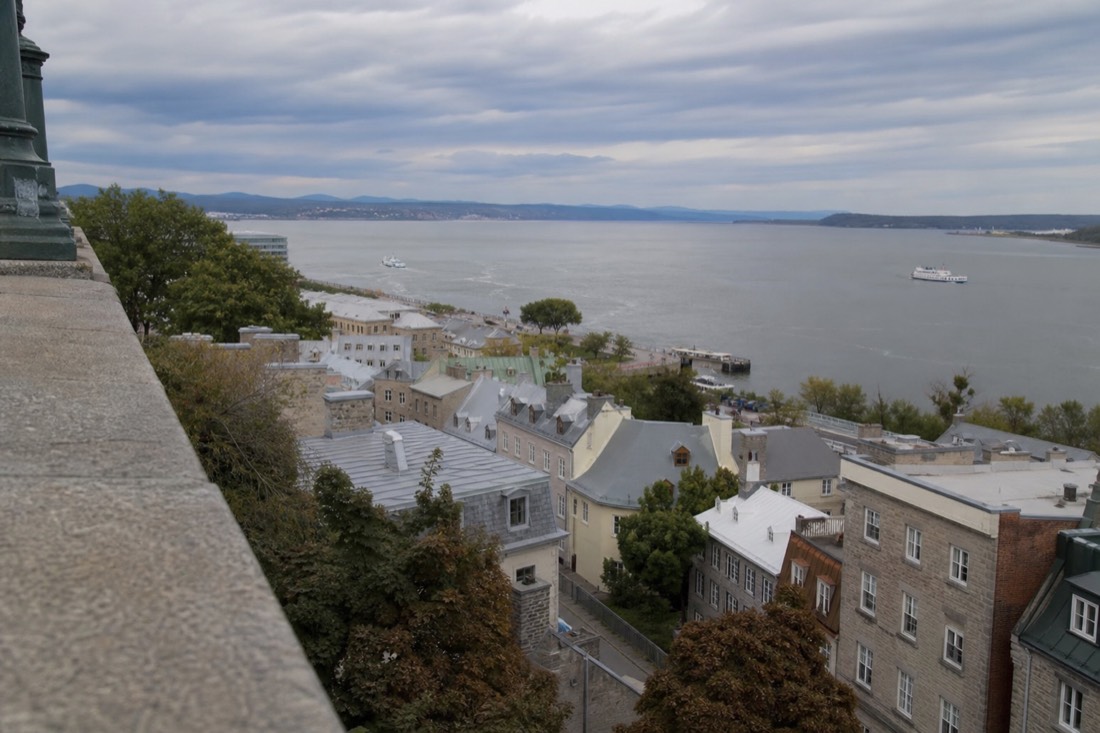
The split is vertical, which surprises people. Upper Town, the part inside the fortifications, holds the Château Frontenac, the boardwalk of Dufferin Terrace, rue Saint-Jean's cafés and the bulk of the hotels, from grand old properties down to family-run auberges in stone houses. Sleep up here and nothing on a first-timer's list is more than a short stroll away. The trade-off is daytime crowds and, in July and August, the highest prices in the city.
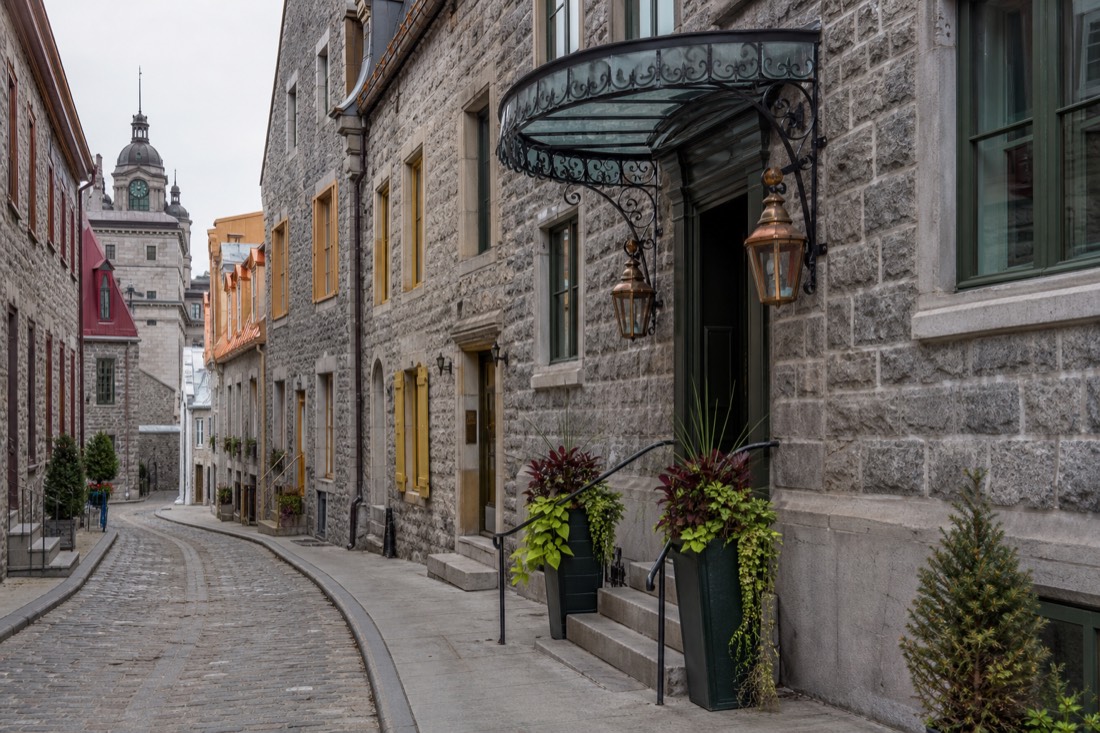
Lower Town is the sliver between the cliff and the river: rue du Petit-Champlain with its hanging signs and mural, Place Royale with one of the oldest stone church squares in North America, narrow lanes that empty out beautifully once the day-trippers leave. Hotels here skew boutique, converted warehouses and merchant houses with a couple dozen rooms. The catch is gravity. Every trip up to the terrace or the walls means the funicular, the Casse-Cou stairs, or a looping walk around by côte de la Montagne.
My honest take after four years of guiding: pick Lower Town for a romantic two-night stay, Upper Town for everything else. And before you anchor yourself to either, spend your first morning crossing between them on foot. The classic route on the walking tours page covers both towns with the funicular ride built in, and you can check live availability & prices on Viator before you arrive. Two hours in, you will know exactly which half of the city feels like yours.
What Part Of Quebec City Is Best To Stay In?
For a first visit, inside the walls in Upper Town, full stop. But five areas genuinely compete: Upper Town for sights at the door, Lower Town for charm, the Old Port for flat walking and cruise logistics, Saint-Roch for restaurants and value, and the Beauport shore near Montmorency for travellers with a car.
Here is how the five bases compare. Price bands are relative to each other, not fixed rates, because hotel pricing here swings hard with the season; summer and Carnival weekends push everything up a tier.
| Area | Vibe | Walkability to the main sights | Relative price band |
|---|---|---|---|
| Upper Town (inside the walls) | Postcard heritage, café streets, the Frontenac skyline | Everything at your door | $$$$, the city's peak |
| Lower Town / Petit Champlain | Boutique, romantic, lantern-lit lanes | Excellent, with a cliff to climb | $$$$, small inns fill first |
| Old Port | Riverside, antiques on rue Saint-Paul, quieter | Very good, and mercifully flat | $$$ |
| Saint-Roch | Local, young, restaurant-dense | Fair: 20 to 30 minutes on foot, uphill coming back | $$ |
| Near Montmorency (Beauport) | Motels and auberges, waterfall at hand | Drive or bus into the old city | $ to $$ |
The official tourism office keeps a good plain-language rundown of the city's neighbourhoods if you want to go deeper than five. For trip planning around whichever base you pick, my three-day itinerary slots the neighbourhoods into a walking order that saves your legs.
Is The Château Frontenac Worth Staying At, Or Just Worth Visiting?
Both are legitimate answers. The Frontenac is the most famous hotel in the city and, by long-standing claim, the most photographed hotel in the world, with 610 rooms and suites above Dufferin Terrace. If the budget stretches, one night is a genuine bucket-list stay. If not, the public spaces welcome walk-ins.
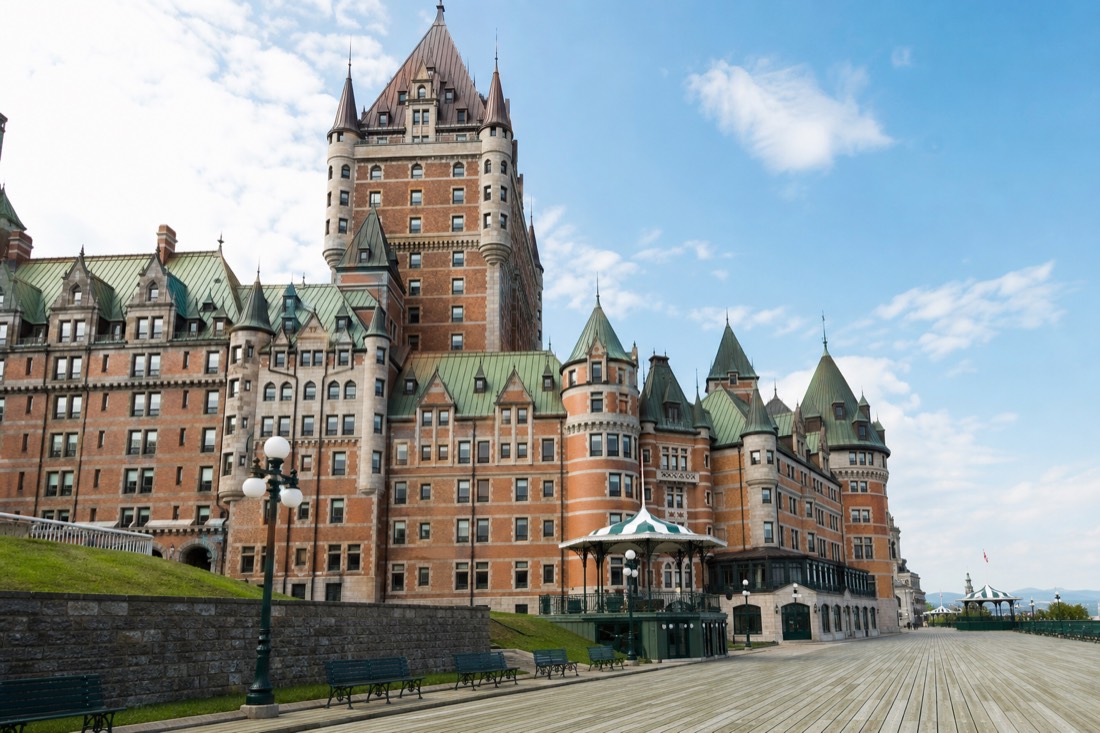
I pass the Frontenac on nearly every tour I run, and the question comes up daily. The short facts, all verifiable:
| Château Frontenac | The record |
|---|---|
| Opened | 1893, built for the Canadian Pacific Railway |
| Architect | Bruce Price, in the châteauesque style that defined Canada's railway hotels |
| Named for | Louis de Buade, Count of Frontenac, governor of New France |
| Size | 610 rooms and suites under those copper roofs |
| Claim to fame | Widely cited as the most photographed hotel in the world |
| History | Hosted the wartime Quebec Conferences of 1943 and 1944, with Churchill and Roosevelt |
| Can you enter without staying? | Yes. The lobby and bars are open to the public, and guided tours of the hotel run for non-guests |
Should you sleep there? If this is an anniversary, a proposal, or a once-in-a-lifetime trip, yes, and book a river-view room far ahead. If you mainly want the photograph, remember the secret every guide knows: the best views of the Frontenac are from outside it, from Lower Town and the ferry, and guests looking out see the river instead of the turrets. I wrote a fuller piece on visiting the Château Frontenac without a reservation, tea and tours included.
Fairmont Le Château Frontenac Check rates ›
Should You Stay Outside The Walls?
Yes, in three cases: you arrive by cruise ship (the Old Port puts the terminal at your feet), you care more about restaurants and value than postcard views (Saint-Roch), or you have a car and Montmorency Falls on the itinerary (the Beauport shore). Everyone else should pay the intra-muros premium.
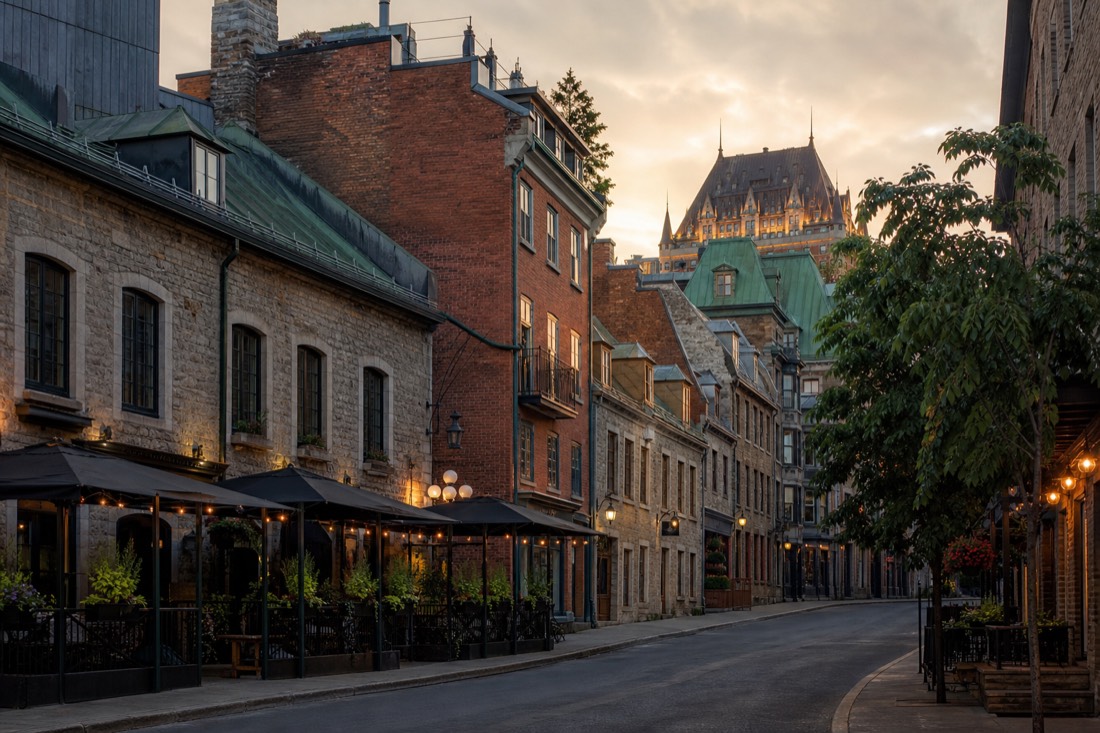
The Old Port is the gentlest compromise. You stay in converted stone warehouses by the marina, browse the antique shops on rue Saint-Paul, and reach Place Royale on flat ground in minutes, no cliff involved. The best-known address here is Auberge Saint-Antoine, a converted riverside warehouse that displays archaeological finds from its own foundations. Ships dock right there, which is why I point every ship passenger to my cruise port guide before they book anything.
Auberge Saint-Antoine (Old Port) Check rates ›
Just outside the Saint-Jean gate, two reliable larger properties sit within a few minutes of the walls: the Hilton faces Parliament Hill with river views from its upper floors, and Le Capitole shares its building with the Capitole theatre on Place D'Youville, steps from the gate itself. Both trade old-stone character for space and predictability, which suits families and longer stays.
Hilton Quebec (Parliament Hill) Check rates ›
Hôtel Le Capitole (Place D'Youville) Check rates ›
Saint-Roch, down the hill to the northwest, is where my neighbours actually eat. Rue Saint-Joseph runs thick with microbreweries, ramen counters and some of the city's most ambitious kitchens, and hotel rates sit a clear band below the old town. The walk back up to the walls takes twenty-odd minutes and finishes on a slope, so budget for the occasional taxi after a long dinner.
The Beauport shore is a different trip entirely. Motels and roadside auberges line the route east toward Montmorency Falls, which drop 83 metres, higher than Niagara, into the St. Lawrence about a fifteen-minute drive from the old city; the park's details are on the Sépaq site. Stay out here only if you are driving. With a car it works beautifully as a waterfall-first base, and the Montmorency Falls tours page covers the options if you would rather leave the driving to someone else. My falls guide has the cable car and footbridge details.
How Far Is Each Base From The Sights You Will Actually Visit?
Everything inside the walls is a walk. Old Quebec's historic district covers about 1.35 square kilometres, so the honest difference between bases is measured in minutes and in vertical metres, not in kilometres. The one real gap is the Beauport shore, 13 km east of downtown, where a car stops being optional.
The table below is the one I wish booking sites published. Distances in this city lie, because a five-minute walk on the map can be a cliff, and the reverse is also true: the Old Port looks far from Upper Town and is not, it is simply below it. Everything here is a planning allowance from walking these routes weekly, at the pace of someone stopping to look at things rather than a fitness tracker.
| From your base | Dufferin Terrace | Petit Champlain | Citadelle and the Plains | Montmorency Falls |
|---|---|---|---|---|
| Upper Town, inside the walls | 2 to 10 min, level | 5 to 10 min via funicular or the 59 steps | 10 to 20 min on foot | 15-minute drive, 13 km |
| Lower Town / Petit Champlain | 5 to 10 min, cliff or funicular | At the door | 20 to 30 min, uphill throughout | 15-minute drive |
| Old Port | 10 to 15 min, flat then a climb | 5 to 10 min, flat | 25 to 35 min | 15-minute drive |
| Saint-Roch | 20 to 30 min, uphill coming back | 20 to 25 min | 25 to 35 min | Drive or bus |
| Beauport, near Montmorency | Drive or bus into the old city | Drive or bus | Drive or bus | Next door |
Two things fall out of that grid. Lower Town is closer to everything and higher-effort to reach anything above it, which is the whole Upper versus Lower argument in one line. And Saint-Roch's twenty-odd minutes is genuinely fine at the start of a day and genuinely annoying at the end of one, uphill, in February.
When Do Quebec City Hotels Fill Up?
Three windows do the damage: July, Carnival and the Christmas market. Carnival runs February 5 to 14 in 2027 and draws a festival crowd of nearly 400,000 a year into the coldest fortnight on the calendar. The market runs November 19 to December 23, 2026. September is the value month.
Inventory inside the walls is the constraint, and it does not grow. The old town holds a fixed number of rooms in stone buildings that cannot be extended, with the Château Frontenac's 610 rooms accounting for a large share of them and the rest split among boutique properties counting rooms in dozens. Monsieur Jean, for scale, has 78. When a headline event lands, the small inns sell out first and the price of everything left goes up.
Which is why the calendar matters more than the neighbourhood when you book. A mediocre room inside the walls during Carnival costs more than an excellent one in Saint-Roch in September. The best time to visit guide has the full year, but for accommodation specifically, the pattern below is what I watch.
| Window | Dates | What happens to rooms | Book by |
|---|---|---|---|
| Deep winter, outside Carnival | January into early February | The quietest stretch of the year, and the cheapest | A few weeks out is plenty |
| Winter Carnival | February 5 to 14, 2027 (the 2026 edition ran February 6 to 15) | Intra-muros sells out first, rates jump | Months ahead for anything inside the walls |
| Spring | April and May | Shoulder rates, cruise season opens in May | A few weeks |
| Summer peak | June to August, with the Festival d'été in July | Highest rates of the year, small inns gone first | Months ahead |
| Fall colour | Late September into early October | Colour peaks, and September rates run 35 to 40 percent below summer | Weeks ahead, and the best value on the calendar |
| Christmas market | November 19 to December 23, 2026 | December weekends inside the walls go first | Months ahead for a weekend |
What Should You Check Before Booking A Heritage Room In Old Quebec?
Ask about stairs before you ask about the view. These hotels sit in stone buildings that predate lifts, on a site of roughly 1.35 square kilometres of cobbles and slopes. Luggage, knees and a late winter arrival all care far more about the staircase than about the decor in the photographs.
Nothing on this list is a complaint about heritage properties. They are the reason to sleep here. But a converted merchant house is not a chain hotel, and the things that go wrong are the same handful every time: three flights with no lift, a taxi that cannot reach the door because the lane is pedestrian, a check-in desk that closes before your train arrives, or a parking assumption that collapses on contact with the old town.
Run this checklist against any address before you pay. It takes one email, and the answers also tell you what kind of property you are dealing with. If the reply is quick and specific, that is usually a good sign about the rest of the stay.
| What to check | Why it matters here | What to ask |
|---|---|---|
| Lift, or how many flights | Many old-town buildings have no lift at all | "How many steps from the street to the room, and is there a lift?" |
| Taxi and luggage access | Some lanes are pedestrian or too narrow for a drop-off at the door | "Where does a taxi actually stop, and how far do we wheel bags over cobbles?" |
| Late check-in | Small inns and auberges do not all staff a 24-hour desk | "What is the latest arrival you can take, and is there a key box?" |
| Parking | Inside the walls it is limited; the city lot runs $2 per 20 minutes, capped at $21.50 a day | "Do you have parking, and what does it cost per night?" |
| Getting home after 9 p.m. | The funicular runs 9 a.m. to 9 p.m., so a Lower Town base means stairs or a road detour late | "Which route do guests use back up after the funicular closes?" |
| Winter footing | Slopes and cobbles ice over, and the walk from the taxi is the risky part | "Is the approach to the entrance cleared and salted?" |
| Noise | Terrace streets are lively until late in summer | "Do the rooms face the street or a courtyard?" |
| Cruise timing | The season runs May to October, and turnaround days move a lot of luggage | "Can you hold bags before check-in and after check-out?" |
Which Area Fits Your Kind Of Trip?
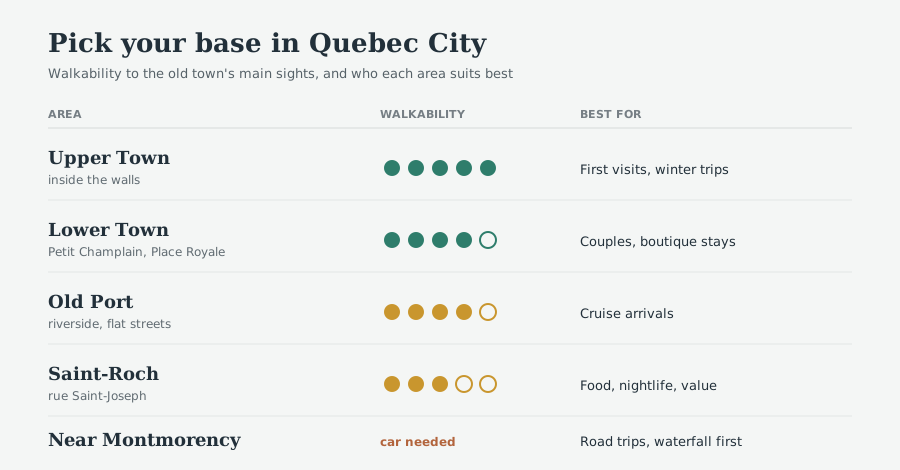
Match the base to the trip, not to a stranger's favourite. First-timers and winter visitors belong inside the walls, couples below the cliff, cruise passengers by the terminal, food-focused travellers in Saint-Roch, and drivers out east. The city is compact enough that no honest choice ruins a visit.
| Your trip | Stay in | Why it wins |
|---|---|---|
| First visit, no car | Upper Town | Every headline sight within a ten-minute walk |
| Romantic break | Lower Town / Petit Champlain | The prettiest streets in Canada, calm after dark |
| Bucket-list splurge | Château Frontenac | The building is the destination |
| Cruise arrival or departure | Old Port | Terminal, taxis and flat streets together |
| Food and nightlife on a budget | Saint-Roch | Best restaurant density per dollar in the city |
| Road trip with kids | Beauport, near Montmorency | Parking is easy and the waterfall is next door |
| Winter Carnival trip | Inside the walls | You will not want a long cold walk home |
One practical note that outranks any neighbourhood debate: this is a walking city with hills, cobbles and, in winter, serious ice. Wherever you sleep, plan your days on foot and treat the bus and funicular as relief for tired legs. My getting around guide breaks down the funicular, the ferry and the bus network so you can test any address against real routes before you book it.
Your Next Step
Choose Your Quebec Experience
General recommendation, before you add preferences. Confirm dates and participation requirements with the operator.
Have your travel date in mind? Connect Place Royale, Petit Champlain and the upper town with a licensed guide and an included funicular ride. Check the departure before arranging the rest of your day.
2 hours; meet at 112 Rue Saint-Paul and finish near City Hall. Hotel pickup is excluded.
Departure schedule from Viator; final availability and price are confirmed on Viator.
Compare Options And Fit Your Plans
Connect Place Royale, Petit Champlain and the upper town with a licensed guide and an included funicular ride. 2 hours; meet at 112 Rue Saint-Paul and finish near City Hall. Hotel pickup is excluded.
Taste poutine, pea soup and maple treats across a guided Old Quebec food walk. 3 hours, English guide. Menus can change; dietary substitutions require advance confirmation.
See the waterfall from above and below with the park’s cable-car visit. Park admission, round-trip cable car, terminal parking and local taxes included. Arrange your own transport. Zipline and via ferrata are separate. Allow three hours including your own city-to-falls return journey. This is a planning allowance, not a fixed ticket duration.
Combine guided Lower Town stories with a round-trip ferry crossing and views from Lévis. 2 hours in English or French; meet at the Wolfe-Montcalm Monument, 7 Rue des Carrières. Ferry fare is included; this is a walking outing with a river crossing.
Affiliate links: we may earn a commission at no extra cost to you.